Perhaps the element which best defines
Asturian culture in terms of its synthesis of different ecological,
techno-economic, sociological and ideological elements is the traditional
homestead. We use the term in the context of traditional Asturies advisedly,
referring not only to the actual living space but also to the area immediately
surrounding the rural homestead or caseria, which may best be described as
constituting a production tool, a farming unit which would not only serve as a
family dwelling place but would also accomadate livestock in seperate stables
or styes, be able to store grain in the horreo (a wooden granary built atop
pillars), barn-building for the storage of straw and space for the storage of
the harvests, straw and tools, as well as an allotment and a space reserved for
fruit trees, land for the cultivation of cereals which could be turned into
bread, and grazing and wooding rights upon the common land of the
mountainside.
The central element of the rural homestead or farmstead was its family
living-space, which would be made the most of according to different formal
solutions all across Asturian territory, the exact form depending generally
upon enviromental factors (geology, altitude, orientation and topography of the
different settlements), chronological and cultural factors connected to
tradition and the economic capacity of its occupants. This last factor was to
have a decisive influence upon the design and size of the buildings constructed
and upon the incorporation of stylistic elements into the rural enviroment. The
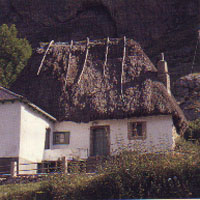
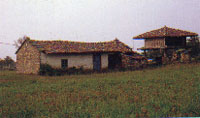
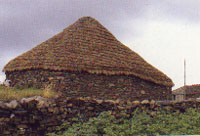
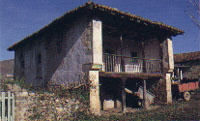
interaction of these factors result in a rich typology which includes the
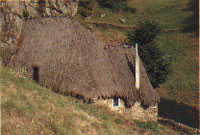
archaic roundhouse in which people and stock shared the same space - one of the
oldest habitations to be found in Europe, with its roots in the
characteristically round or curvilinear dwellings of the Iron Age fortified
villages - as well as its later incarnations, such as the walled passage-house
copied from urban models documented in Asturian cities and market towns in the
fifteenth and sixteenth centuries, or the larger and more comfortable casones
displaying a Baroque influence, typical of well-todo country-dwellers.
It is not too late to follow this complex evolution step by step through the
architectonic elements which still survive in Asturies; in 1978 the English
architect Mark Gimson was to describe Me more elemental types of dwelling thus:
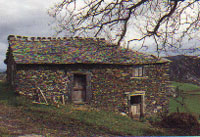
"In the place called La Braña, near to Cangas del Narcea, I found
and measured a house which is the best example I have seen of a rectangular
version of the palloza (house with a curvilinear groundplan and a thatched
covering). The discovery of these houses is extremely important for Celtic
studies in Great Britain and Ireland, because they constitute a link missing
from the evolution of vernacular constructions. Archeologists in Great Britain
have excavated roundhouses in the hill-forts very similar to those of the
fortified villages of the north-west of Spain and the citanias found in
Portugal. One of the characteristic houses which may be termed Celtic is the
long-house, one-storey dwellings in which animals occupied one half and humans
the other, generally alongside a hay-barn, with the dwelling place in the
middle.
Nevertheless, until now it has not been possible to show whether any
relationship existed between the houses of the hill-forts and the long-houses.
The verosimilitude of such an evolution may be seen in the existence in the
north-west of Spain not only of fortified villages and houses similar to
long-houses, but also the majority of their intermediary stages.